• Skip to primary navigation
  • Skip to main content
  • Skip to primary sidebar
  • Skip to footer

HVS

Helium Leak Detection

MENUMENU
  • 570-676-9417
  • Quick RFQ
MENUMENU
  • Helium Leak Detectors
    • Agilent
      • HLD PR02Portable Helium Leak Detector
      • HLD PD03Portable Dry Helium Leak Detector
      • HLD BD15Bench Dry Helium Leak Detector
      • HLD BR15Bench Helium Leak Detector
      • HLD BD30Bench Dry Helium Leak Detector
      • HLD BR30Bench Helium Leak Detector
      • C15 ComponentComponent Helium Leak Detector
      • PHD-4 SnifferPortable Helium Leak Detector
    • Varian
      • VS PR02Portable Helium Leak Detector
      • VS PD03Portable Dry Helium Leak Detector
      • VS BR 15Bench Helium Leak Detector
      • VS MR 15Mobile Helium Leak Detector
      • VS MD 30Mobile Dry Helium Leak Detector
      • VS BD 30Bench Dry Helium Leak Detector
      • 979 SeriesHelium Mass Spectrometer
      • 959 SeriesHelium Mass Spectrometer
      • 938-41Portable Helium Leak Detector
      • 936-40Helium Leak Detector
    • Pfeiffer adixen
      • MiniTest 300Portable Helium Leak Detector
      • ASM 310Portable Helium Leak Detector
      • ASM 340Multipurpose Helium Leak Detector
      • ASM 340 DMultipurpose Dry Helium Leak Detector
      • ASM 340 IMultipurpose Helium Leak Detector
      • ASM 182 THigh Performance Compact Helium Leak Detector
      • ASM 182 TD+High Performance Compact Helium Leak Detector
      • ASM 192 THigh Performance Console Helium Leak Detector
      • ASM 192 T2D+High Performance Console Helium Leak Detector
      • ASM 380High Performance Mobile Helium Leak Detector
      • ASM 390High Performance Mobile Helium Leak Detector
      • ASM 392High Performance Mobile Helium Leak Detector
      • ASM 1002Workstation Helium Leak Detector
      • ASM 102 SSniffer Leak Detector
      • ASI 35Modular Helium Leak Detector
    • Alcatel adixen
      • ASM 10Portable Helium Leak Detector
      • ASM 110 Turbo CLPortable Helium Leak Detector
      • ASM 120 hPortable Helium Leak Detector
      • ASM 142 SSniffer Helium Leak Detector
      • ASM 180 TDPortable Dry Helium Leak Detector
    • Leybold Oerlikon
      • PHOENIX QuadroPortable Helium Leak Detector
      • PHOENIX MagnoHigh Performance Helium Leak Detector
      • PHOENIX VarioPortable High Performance Helium Leak Detector
      • PHOENIX L300iPortable Helium Leak Detector
      • PHOENIX L340iPortable Helium Leak Detector
      • PHOENIX L320i FabMobile Helium Leak Detector
      • PHOENIX L500iMobile Helium Leak Detector
      • UL-100Portable Helium Leak Detector
      • UL-200Portable Helium Leak Detector
    • Edwards
      • Edwards 300EPortable Helium Leak Detector
      • ELD500 WETPrecision Helium Leak Detector
      • ELD500 DRYPrecision Dry Helium Leak Detector
      • ELD500 FLEXPrecision Helium Leak Detector
    • VIC (Veeco)
      • MS 40GTPortable Helium Leak Detector
      • MS 50High Speed Production Console Helium Leak Detector
      • MS 60Portable Helium Leak Detector
      • MD-490SPortable Dry Helium Leak Detector w/ Sniffer
    • Inficon
      • UL1000Mobile Helium Leak Detector
      • ISH2000Hydrogen Leak Detector
    • Handheld
      • LeakHunterHandheld Leak Detector
      • GasCheckHandheld Leak Detector
  • Helium Leak Testing
        • In-House Leak TestingOur Product Leak Testing Services
        • Field ServicesOur Leak Detection Field Services
        • Power GenerationHelium Leak Testing Services for Power Plants
        • Condensers & TurbinesHelium Leak Detection Services for Power Plants
        • Oil & Gas IndustryHelium Leak Detection Services for the Oil & Gas Industry
        • Petroleum PipelinesHelium Leak Testing for Petroleum Pipelines
        • Storage TanksHelium Leak Testing for Storage Tanks
        • General IndustrialHelium Leak Detection Services for General Industry
        • Vacuum FurnacesHelium Leak Detection Services for Vacuum Furnaces
        • LyophilizersHelium Leak Testing for Lyophilizers
        • Absorption ChillersHelium Leak Detection Services for Absorption Chillers
        • Research & DevelopmentHelium Leak Detection Services
        • Linear AcceleratorsLeak Detection Services for LINACS
        • Helium Leak DetectionWhat is Helium Leak Detection?
        • Leak Testing Gallery
        • Resources & Tools
          • Unit Conversion Tool
          • Leak Rates
  • Leak Detector Rental
  • Leak Detector Repair
  • Contact
    • About Us
    • Blog
Home | What Is Helium Leak Detection

What Is Helium Leak Detection

Helium Leak Detection
Helium is the best choice of tracer gas to find leaks for a number of reasons.  It is non-toxic, inert, non-condensable, non-flammable and not normally present in the atmosphere at more than trace amounts (5 ppm).   Due to its small atomic size, helium passes easily through leaks.  The only molecule smaller than Helium is Hydrogen which is not inert.  It is also relatively inexpensive and is available in various size cylinders.

Helium Leak Detection

A helium leak detector, also known as a Mass Spectrometer Leak Detector (MSLD), is used to locate and measure the size of leaks into or out of a system or containing device.   The tracer gas, helium, is introduced to a test part that is connected to the leak detector.  The helium leaking through the test part enters through the system and this partial pressure is measured and the results are displayed on a meter.

Helium leak detectors consists of the following components:

  • A spectrometer to detect the mass of helium
  • A vacuum system to maintain the pressure in the spectrometer
  • A mechanical pump to evacuate the part to be tested
  • Valves which enable the various stages of detection: evacuation, test & venting
  • An amplifier and readout instrumentation to monitor the output signal
  • Power supplies and controls
  • Fixturing that attaches the part to be tested to the detector

Methods of Leak Testing Parts

There are two main methods to leak test parts using helium: vacuum testing (outside-in) and pressure testing (Inside-out).  The detection method should be selected based on the working conditions of the part to be tested.  It is important to maintain the same pressure conditions during the test as will exist during the actual use of the part.  Vacuum systems should be tested with a vacuum inside the chamber.  A compressed air cylinder should be tested with high pressure inside the cylinder.

Vacuum Testing (Outside-in)

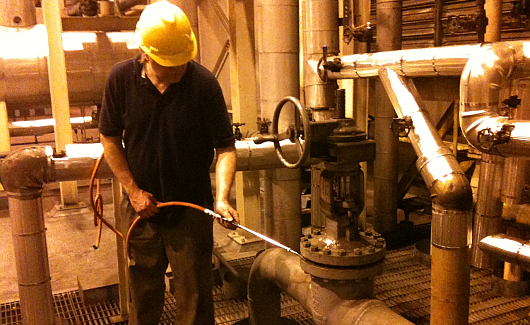
In vacuum testing, the part is evacuated with a separate pumping system for larger volumes, or within the detector itself for smaller volumes.  To locate a leak, helium is administered to the suspected leak sites of the part using a spray probe with an adjustable flow.

Pressure Testing (Inside-out)

In pressure testing, the part is pressurized with helium or a mixture of helium and air.  To locate a leak, the potential leak sites of the part are scanned using a sniffer probe connected to the inlet of the leak detector.

Leak Testing Vacuum Systems & Pressure Systems

Vacuum systems and pressure systems should be leak tested under the same conditions as their operational conditions.  Vacuum systems are tested with a portable leak detector.  The leak detector is connected to the line of the vacuum pump.   Helium is applied to the the potential leak site using a spray probe.  If a leak exists, helium enters the system and quickly diffuses through it.  The leak detector should respond within seconds.  Pressure systems can be charged with helium or a mixture of helium and nitrogen.  The leak testing is performed by using a Sniffer probe.

Helium Leak Detection Applications

Quality control of production parts and assemblies using helium leak detectors can help assure the integrity of your production process.  Typical examples include: hermetically sealed packages, valves, manifolding, seals, vacuum vessels and systems, medical devices, high purity piping, brake lines, fuel lines, hydraulic lines, refrigeration assemblies, radiators, heat exchangers, condensers, storage tanks.

Maintenance of Systems

Industrial process tools that use vacuum systems or pressure systems must be tested to check for occasional leaks.  This can be part of preventative maintenance  or in the event of an unexpected failure.   Typical examples of vacuum systems include: Vacuum furnaces, vacuum coaters, electron microscopes, glove boxes, linear accelerators, electron beam and ion beam process equipment, semiconductor process equipment, laser process equipment.  Typical examples of pressurized systems include: power plants, gas handling systems, bioreactors, liquid gas facilities, underground tanks, underground cables and pipes.

IN-HOUSE LEAK TESTING

Learn more about our in-house leak testing services. See our rates.

In-House Leak Testing

ON-SITE LEAK TESTING

Learn about our leak detection field services. See our rates.

On-Site Leak Testing

Primary Sidebar

Rental Forms & Warranty

Rental Form

Download our leased equipment terms and conditions.

Warranty

Download our warranty on rebuilt and used leak detectors.

RMA Form

Download our RMA form.

Resources

Unit Conversion Tool

Calculate Flowrate, Leakrate, Pressure & Volume.

Quick RFQ

Quick RFQ

Footer

Target Services

  • LINAC Leak Testing
  • Condenser Leak Testing
  • Turbine Leak Testing
  • Pipeline Leak Testing
  • Vacuum Furnace Leak Testing
  • Lyophilizer Leak Testing
  • Leak Detector Rentals
  • Leak Detector Repairs

Helium Leak Detectors

  • Adixen Leak Detectors
  • Alcatel Leak Detectors
  • Agilent Leak Detectors
  • Edwards Leak Detectors
  • Leybold Leak Detectors
  • Pfeiffer Leak Detectors
  • Varian Leak Detectors
  • VEECO/VIC Leak Detectors

Worldwide Services

Serving the vacuum needs of North America since 1986.  We can provide vacuum system solutions, leak detection, and leak detectors anywhere in the world.

Contact Us

HVS Leak Detection
Greentown, PA 18426

Phone: 570-676-9417
Fax: 570-676-0544

Send us an email

Connect

  • Facebook
  • LinkedIn
  • Twitter
  • YouTube

Deprecated: Hook genesis_footer_creds_text is deprecated since version 3.1.0! Use genesis_pre_get_option_footer_text instead. This filter is no longer supported. You can now modify your footer text using the Theme Settings. in /home2/hivac/public_html/wp-includes/functions.php on line 6078

© 2024 Siteby DMR